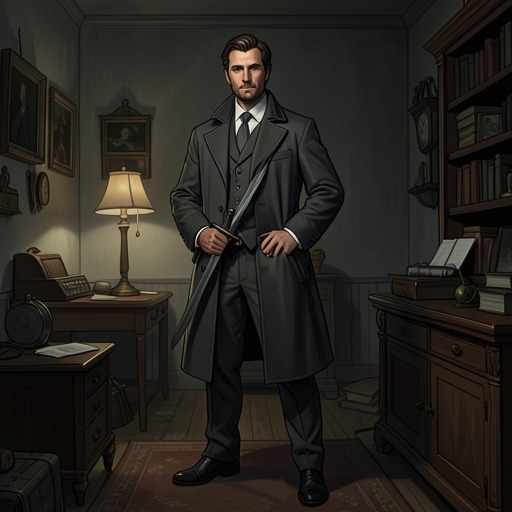
Cyrano interrupts Montfleury’s performance
Cyrano de BergeracCyrano interrupts Montfleury’s performance at the Hotel de Bourgogne by making his private ban on the actor a public command. The scene begins as entertainment and ends with Montfleury driven through a stage trap, the audience laughing and whistling, and the theater’s ordinary performance abruptly displaced by Cyrano de Bergerac’s forceful presence.
Setting and Trigger
An air on the drone-pipes accompanies Montfleury’s entrance. Enormously stout and dressed as an Arcadian shepherd, he wears a rose-wreathed hat drooping over one ear and blows into a ribboned drone pipe. He begins reciting pastoral verse when a voice from the middle of the pit denounces him and asks whether he had not been forbidden to show his face there for a month. The interruption exposes a prior order: Montfleury’s appearance is not merely unwelcome to the speaker but expressly prohibited.
The response in the theater is immediate. The audience falls into general stupor; people turn around, and murmurs spread. The performance has become a public confrontation before the actor has finished his opening lines. Rather than withdrawing or explaining the order, the speaker reveals himself as Cyrano de Bergerac, appearing suddenly in the pit and standing on a chair.
The Expulsion
Cyrano’s entrance makes his appearance part of the command. He stands with his arms crossed, his beaver cocked fiercely, his mustache bristling, and his nose described as terrible to see. He warns that he will soon become angry. Montfleury nevertheless tries to continue, managing only another fragment of his verse before Cyrano counts, “Two!” When Montfleury begins again, Cyrano answers, “Three!”
At the count’s completion, Montfleury disappears as through a trap. The action is decisive and visible: Cyrano does not debate the actor’s right to perform or wait for the audience to resolve the dispute. His numbered warning sets a limit, and its final beat is immediately followed by Montfleury’s removal from the stage.
Audience and Immediate Aftermath
The theater answers the expulsion with a tempest of laughter and whistling cries. The crowd’s reaction gives the interruption a second life as spectacle: the event that stops the play becomes, in its own right, a scene performed before the house. Cyrano has interrupted Montfleury’s fiction, but the sudden entrance, warning, countdown, and disappearance produce a sharply theatrical sequence of their own.
Bellerose says that the entrance fees must be returned. That response registers a practical consequence of the disruption: with Montfleury gone and the performance stopped, the audience’s paid entertainment has been interrupted. The available scene establishes the proposed refund, but does not show whether it is carried out.
Public Command and Cyrano’s Stage Presence
The episode establishes a contrast between the formal stage and the space from which Cyrano acts. Montfleury enters in elaborate pastoral costume and begins the expected recitation; Cyrano, by contrast, rises from the pit, takes a chair, and commands the actor from below. The theater’s attention shifts from the staged shepherd to the man who can halt the performance. His physical bearing and terse count make authority itself the scene’s spectacle.
The episode also precedes a later public exchange in which a viscount calls Cyrano’s nose very big and Cyrano gravely agrees. In a subsequent speech, Cyrano identifies a duel at the Hotel de Bourgogne as one fought by De Bergerac and a good-for-naught, and describes doffing his beaver before freeing his hand and heel. These later details place the interruption within a theater where Cyrano’s presence is associated not only with stopping a performance but with turning public provocation into a display of wit and action.